
If you've noticed your shipments arriving late, your freight quotes climbing, or your supplier lead times stretching further than usual, you're not alone.
Right now, three key drivers are reshaping how goods move and what they cost to move: the near-shutdown of the Strait of Hormuz, a sharp surge in diesel and bunker fuel prices, and an increasingly unstable tariff environment driven by ongoing trade policy shifts.
Each alone would be significant. Together, they represent the most serious disruption to global logistics costs in years.
This article breaks down what's happening, why it matters to your business, and, most importantly, what you can do about it right now.
Do you need professional help for your business Supply Chain? Reach out to our experts at SARA today.
Why Shipping Costs Are Rising in 2026
Shipping rates had only just stabilised after the post-pandemic disruptions, and now three major pressures hit at once.
The closure of the Strait of Hormuz in February 2026 is now forcing ships to reroute around Africa, significantly increasing transit times and fuel consumption. At the same time, oil prices surged past $100 per barrel, sharply raising bunker fuel costs. On top of that, new tariff uncertainties began driving up landed costs for importers.
The impact has been immediate: container rates on key routes have risen by 20–25%, war surcharges have jumped by nearly 200%, and additional fuel surcharges are now being applied globally, making shipping costs far less predictable for businesses.
Why Ships Are Rerouting Around the Strait of Hormuz
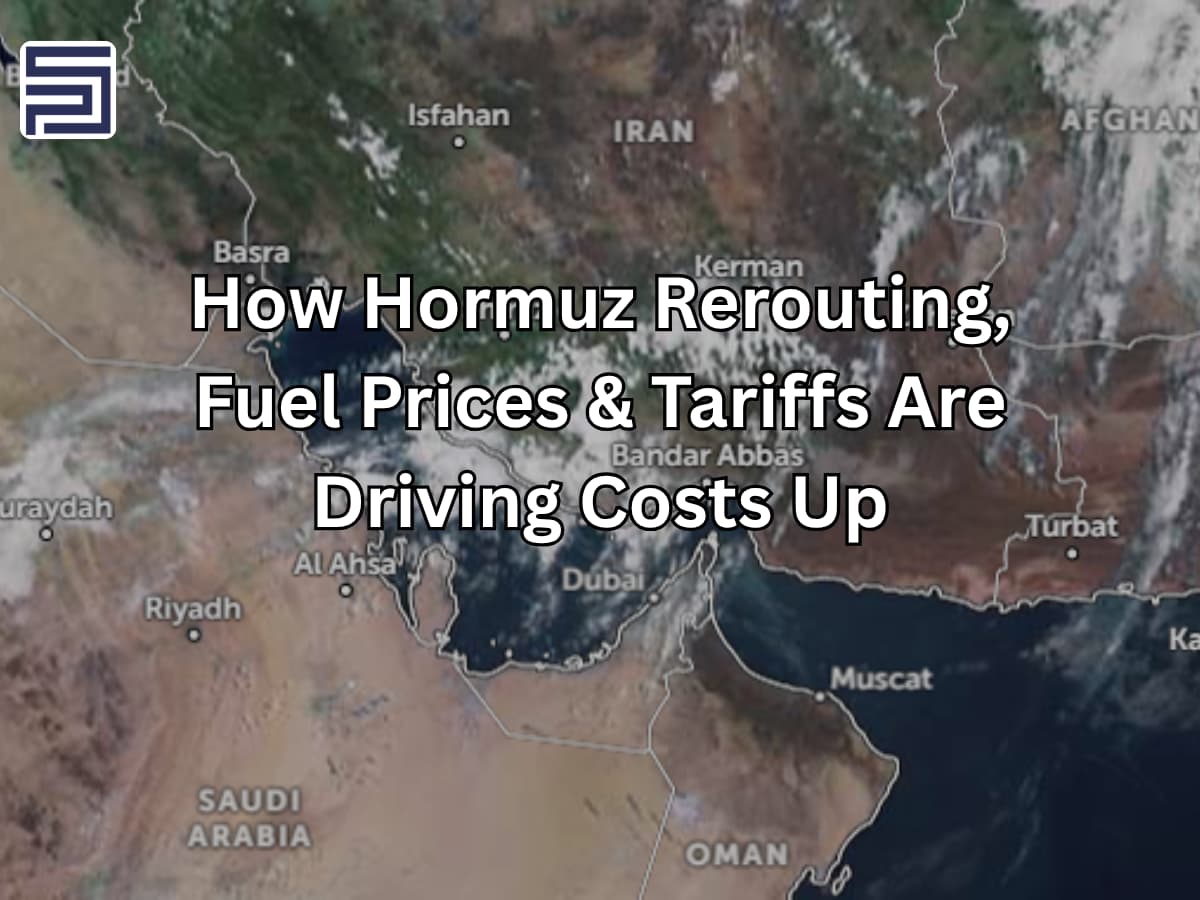
The Strait of Hormuz is a narrow yet critical waterway connecting the Persian Gulf to global markets and serving as the only export route for major oil and gas producers such as Saudi Arabia, the UAE, Iraq, Kuwait, Qatar, and Iran.
It carries about 20% of the world’s oil supply, with most shipments heading to Asia, along with LNG, petrochemicals, and other key goods.
Because there’s no real alternative route for these exports, any disruption has a far greater impact than typical shipping detours.
After military strikes on Iran in February 2026, commercial shipping through the Strait of Hormuz quickly collapsed. Traffic dropped by about 70% within 48 hours and soon fell to near zero as vessels were warned off and attacked.
By mid-March, thousands of ships were stranded or waiting nearby, with hundreds rerouted or stuck in the region. Major carriers suspended transits entirely and began diverting vessels around the Cape of Good Hope.
Before the crisis, the Strait of Hormuz handled massive daily traffic, including over 20 million barrels of oil and numerous cargo vessels.
Since its effective closure in late February 2026, shipping has dropped to minimal levels, with most vessels forced to reroute. Over 34,000 diversions were recorded in just four weeks, showing a major shift in global shipping patterns.
Most ships are now taking the longer route around Africa, adding 20–30 days to transit times and significantly increasing fuel use and overall shipping costs.
How Rising Diesel Prices Are Driving Up Freight Costs
The Hormuz crisis has a direct impact on freight costs through rising fuel prices and added surcharges.
As oil prices surged past $100 per barrel, bunker fuel nearly doubled, significantly increasing shipping costs since fuel makes up 20 – 30% of voyage expenses. Diesel prices also rose sharply, driving up inland transport costs.
In response, carriers introduced multiple surcharges, including fuel adjustments, emergency fees, war risk premiums, and congestion charges, all of which are passed on to businesses.
The result is rapidly rising and highly unpredictable shipping costs, with companies needing to plan for continued volatility.
New Tariff Risks and Their Impact on Global Trade
Global trade was already under pressure from tariff uncertainty before the Hormuz crisis, and that uncertainty has intensified in 2026, adding another layer of cost on top of rising fuel prices and longer shipping routes.
Recent U.S. policy changes, including a new 10% global import surcharge (with potential increases) and ongoing tariffs on key sectors, have created a volatile trade environment.
For businesses, the real challenge is unpredictability. Costs are rising, supply chains are becoming harder to plan, and companies are being forced to rethink sourcing strategies, manage inventory more carefully, and deal with increased compliance.
What This Means for Importers and Businesses
The convergence of these three forces, Hormuz rerouting, fuel surcharges, and tariff instability, is creating specific, concrete challenges for businesses that rely on international trade.
1. Delivery delays are real and extended:
Rerouting via the Cape of Good Hope adds 20 – 30 days to transit times on many routes. But that is just the baseline.
Congestion at destination ports, as diverted ships arrive in waves at alternative hubs that were not designed to absorb the volume, adds further unpredictability.
Industry analysts suggest the real port congestion pressure typically hits 2–5 weeks after the initial disruption, meaning many businesses have not yet felt the worst of it.
For businesses with seasonal inventory needs, promotional deadlines, or production schedules that depend on incoming components, these delays create significant operational risk.
2. Landed costs are rising on multiple fronts simultaneously:
A shipment from Asia to Europe or the US is now facing higher freight base rates, emergency bunker surcharges, war risk surcharges, and higher import duties, all at once.
The combined effect on landed cost can be substantial, particularly for thin-margin product categories.
3. Inventory planning has become harder:
When transit times are unpredictable and costs are volatile, standard inventory models break.
Safety stock assumptions built on historical lead times are likely to be wrong. Businesses that operate lean inventory models are most exposed.
4. Cash flow is under pressure:
Higher freight costs, longer capital tied up in goods in transit, and the possibility of unexpected demurrage and detention charges all increase working capital requirements.
For SMBs without long-term carrier contracts or dedicated logistics teams, this pressure can be acute.
5. The disruption is likely to outlast the immediate crisis:
Even when the Strait of Hormuz reopens, whenever that may be, analysts are clear that supply chain normalisation will take months, not days.
Refineries cannot restart at full capacity overnight. Rerouted vessels are already at sea. Insurance markets will remain cautious. Emergency surcharge structures will take time to unwind.
One Hapag-Lloyd executive put it plainly: “When the war is officially over, and the bombardments are stopped, that does not mean that the war is over for logistics, because then the real work starts.”
How to Reduce the Impact on Your Business
This is not a moment for passive observation. The businesses that come through this period in the strongest position will be the ones that acted early, planned carefully, and built flexibility into their logistics and sourcing strategies.
Here is what you can do right now.
1. Plan shipments earlier and build in buffer time:
If your current lead-time assumptions are based on pre-crisis transit times, they are wrong. Audit your inbound and outbound schedules and add a buffer, a minimum of two to three weeks on affected lanes, and more for goods moving through Gulf hubs.
Communicate revised timelines to your customers and stakeholders now, before the delay becomes a surprise.
2. Review and lock in freight rates where possible:
Spot rates are highly volatile. If you have regular shipping volumes on affected lanes, talk to your freight partner about fixing rates for a defined period. You can work with our shipping expert at SARA to do this.
Locking in before further surcharge increases take effect, particularly the Q2 carrier BAF adjustments, can meaningfully reduce your exposure.
Avoid relying on quotes issued before March 2026 for any future shipments; the cost environment has changed materially.
3. Build safety stock on critical products and components:
For goods with long lead times or specific exposure to Middle East disruption, electronics components, plastics, petrochemical-derived products, and fertiliser-intensive agriculture carry more safety stock than usual.
Experts' analysis recommends planning for 60 – 90 days of continued volatility as a reasonable baseline, regardless of how quickly the Hormuz situation evolves.
4. Diversify your supplier base and sourcing geography:
If your supply chain runs heavily through Gulf ports or depends on a single origin country with limited alternative routing, now is the time to map those exposures and take action. Identify secondary suppliers in alternative geographies.
Consider whether goods that currently transit Gulf hubs can be rerouted through the Indian Ocean or East African alternatives. The Hormuz crisis is accelerating a supplier diversification trend that was already underway in response to tariff pressures. Use it as the catalyst to build the resilience you should have been building anyway.
You can work with our expert product sourcing team at SARA to achieve this.
5. Consolidate shipments where possible:
When individual shipments are delayed and costs are elevated, consolidated freight (i.e. grouping your cargo with other shippers to fill a container) can reduce per-unit costs and improve schedule predictability compared to booking incomplete loads.
6. Establish a regular freight cost review cycle:
In a stable environment, quarterly freight reviews are reasonable. Right now, weekly or bi-weekly reviews are warranted.
Emergency surcharges are being added, modified, and, in some cases, stacked in ways that contract language may not clearly prohibit.
Audit your invoices against your contracts, and push back on double-dipping where a carrier is applying both a BAF increase and a separately named "Hormuz surcharge" for the same underlying fuel cost.
If you need a professional hand to oversee these analyses for you, you can outsource your shipping process to our team at SARA.
7. Communicate with your customers and suppliers:
Proactive, transparent communication about delays and cost pressures protects relationships better than reactive explanations after the fact. If you are passing on cost increases, frame them in context; your customers are living in the same news environment and are likely already aware of the disruption.
Work with SARA to Stay Ahead of Shipping Disruptions
In a volatile market, your logistics partner becomes a key competitive advantage.
SARA works with importers and exporters across global trade lanes to navigate exactly the kind of disruption that 2026 is delivering.
When they are volatile, when routes are closing, surcharges are stacking, and transit times are unpredictable, logistics becomes a strategic function, and the expertise and relationships of your freight partner determine whether your goods move or sit waiting.
SARA helps businesses stay ahead of disruptions through proactive route guidance, clear cost breakdowns, and efficient customs support, ensuring shipments move smoothly even when routes change.
With ongoing tariff uncertainty, SARA also provides advisory support to help importers manage duties, stay compliant, and reduce landed costs.
As shipping disruptions take time to stabilise, having a partner that helps you plan, not just react, keeps your supply chain running while others face delays.
If your freight costs, lead times, or supplier reliability are under pressure right now, SARA can help you assess your exposure and build a plan to reduce it. Get in touch with the SARA team today.



Comments
Please log in to leave a comment.